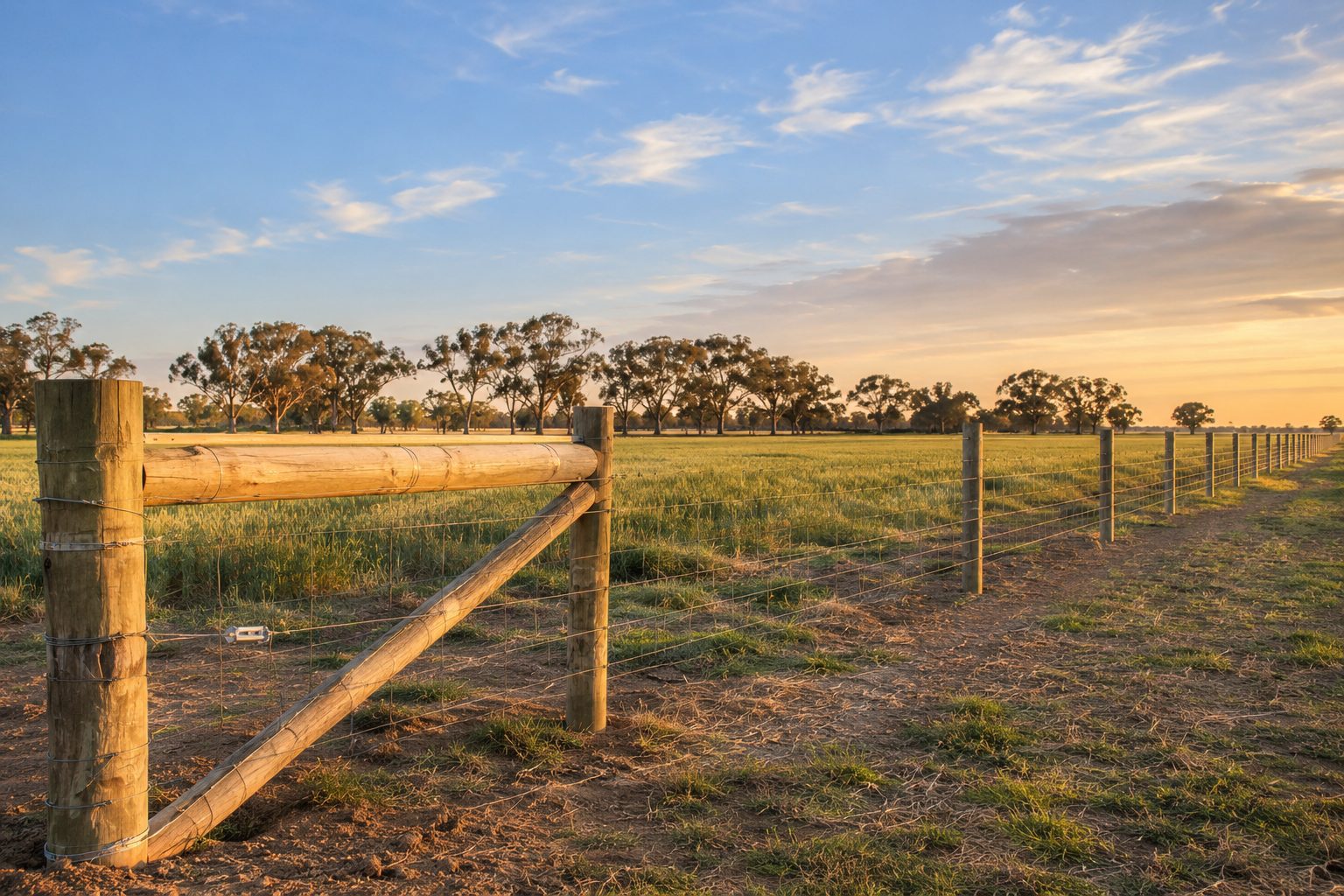
Rural fencing across the Riverina
Rural fencing across the Riverina for stock, boundary, electric, horse and flood or fire repair jobs. Describe the job and your enquiry is passed to a local fencing contractor. This site does not build fences or quote.
Know who the neighbour is, what the fence must hold and what the quote should itemise.
Tell us where the fence is and what it has to do
A photo of the fence line and a rough length are enough to begin.
Request a quote
Flat plains, irrigation channels and grazing country
The Riverina has no single official boundary. Agencies define it differently: the state's Riverina Murray regional plan covers 20 councils (regional plan), a joint organisation of councils has 12 members (joint organisation profile), and a secondary summary of the Local Land Services region gives about 67,000 square kilometres and 17 local governments (regional summary). This site names regions loosely: the Riverina and nearby Murray and Snowy foothills country, taking in the irrigation areas, the cropping and grazing country to the east and the Snowy Valleys.
The councils in the region include Griffith City; Leeton, Narrandera, Hay, Berrigan, Carrathool, Temora, Coolamon, Junee, Lockhart and Bland Shire; Murrumbidgee; Edward River; Murray River; Federation; Cootamundra-Gundagai Regional; and Snowy Valleys.
The Murrumbidgee Irrigation Area around Leeton and Griffith was established in 1912, with towns designed by Walter Burley Griffin in 1914 (secondary source). A rice industry body says most of Australia's rice grows in the Murrumbidgee and Murray valleys (rice industry body). Further south, an irrigator-owned district reports 2,755 km of earthen channels, and its Mulwala Canal runs 156 km through Berrigan, Finley and Deniliquin (irrigation company history page).
Annual rainfall averages 372 mm at Deniliquin Airport and 403 mm at Griffith Airport, 519 mm at Temora Airport, and about 790 mm at the closed Adelong (Tumut Street) station, the nearest station we could read for the Tumut area.
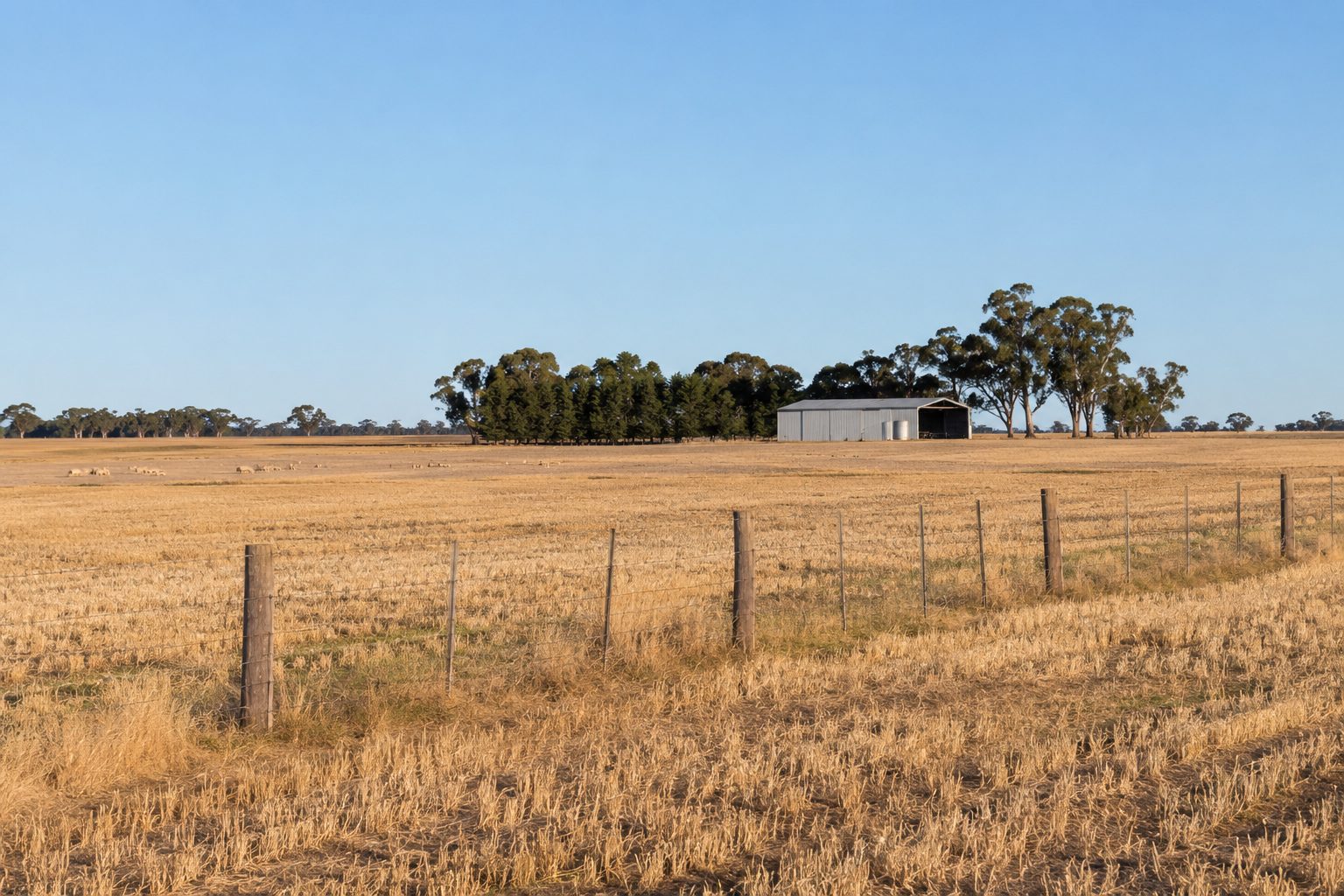
Rural fencing by town and district
Griffith
Vineyard, orchard and horticulture blocks and the irrigation area.
Read more →Leeton
Rice, grain and channel country, with Narrandera and Coleambally.
Read more →Deniliquin
Channel, sheep and floodplain properties, with Hay and Conargo.
Read more →Temora
Cropping and mixed sheep country, with Coolamon, Junee and Lockhart.
Read more →Tumut
Cattle, plantation edges and foothills, with Adelong and Gundagai.
Read more →Rural fencing services across the Riverina
Sheep & cattle fencing
Wire grades, end assemblies and what a quote should name.
Read more →Farm boundary fencing
Working with a neighbour: the order of events and the quote.
Read more →Electric fencing
Energisers, earthing, running parts and flood country.
Read more →Flood & fire damaged fence repair
First steps, flood design ideas and fire permits.
Read more →Horse & lifestyle block fencing
Rail, wire and electric options for small paddocks.
Read more →What to settle before you book
- Town and council areaSay the town and which council covers the land.
- What the fence must holdSheep, cattle, horses or pest animals. See the stock, horse and pest animal pages.
- Boundary or internal fenceA boundary fence brings in a neighbour.
- Who the neighbour isA farm, a lifestyle block, a road, a stock route or Crown land. See roads and stock routes.
- Ground, flood and fireSay if the line floods or burns. See the repair page.
- Access to the fence lineGates, channels and tracks decide when a contractor can get in.
- Whether a notice has been servedSay when. Work done before agreement may not be shared.
- A written quote and the licenceItemised, with the licence or registration the contractor says applies.
The Dividing Fences Act in short
The Dividing Fences Act 1991 deals with dividing fences between neighbouring owners. This is the process in plain words.
| Point | What the sources say |
|---|---|
| Starting point | Adjoining owners usually share the cost equally (the Act, in the version dated 7 December 2024). |
| Higher standard | An owner who wants a higher standard pays the excess. |
| Notice | A written notice states the boundary line, the work and the estimated cost (Legal Aid NSW). |
| Waiting | If owners do not agree within one month, either may apply to a court or tribunal. Sources disagree on which, so check. |
| Public land | Roads, reserves and Crown land raise separate questions that the sources do not settle. |
Check the current Act on legislation.nsw.gov.au. The dividing fences guide has the steps, and the boundary fencing page shows how to prepare the job.
Licensing: what the page we found says, and where it stops
Whether a NSW licensing rule reaches rural fencing is a question we could not settle. The one NSW Government fencing page we found describes fencing on residential property boundary lines and does not mention farms or paddocks, so this site says nothing either way. Put the question to the contractor, check NSW Government licence guidance, and ask NSW Fair Trading or Building Commission NSW if you are unsure.
Planning approval, native vegetation clearing and licensing are three separate questions. See the approvals guide and the contractor guide.
What this site cannot do
This site cannot build, quote, inspect or sign off a fence. It cannot tell you which licence or registration a contractor holds or whether one applies to your job, because the page we found does not say, and it cannot confirm that any contractor holds one. It cannot say where your boundary falls, serve a notice, settle a dispute or issue a permit. Those belong to the contractor, the regulator, the council, a surveyor, a solicitor and a court or tribunal.
Check the current rules before you rely on this
This page describes the Riverina as the site uses the term, how a shared farm fence is arranged and what the page we found says about contractor licensing. It describes the rules in general terms as they stood in November 2026. Standards, forms, thresholds and fines change.
The authoritative sources are Dividing Fences Act 1991 (NSW), in-force version dated 7 December 2024 (check the current version), NSW Government, fencing work (licences and credentials; speaks about fencing on residential property boundary lines), NSW Planning, Riverina Murray Regional Plan 2041, Bureau of Meteorology, Deniliquin Airport AWS climate statistics (station 074258) and NSW Planning, fences (exempt and complying development). Where anything here differs from those sources, they are right and we are not.
We are not fencing contractors, builders, regulators or lawyers. For what applies to your fence, ask the contractor which licence or registration they hold for your job, then ask NSW Fair Trading or Building Commission NSW if you are unsure, and ask the council that covers the land.
Accurate at the time of writing, November 2026. Always check the source before relying on it.
Towns and districts covered:
Read before you compare quotes
What affects the cost
What moves a quote.
Read more →Choosing a contractor
Comparing written quotes.
Read more →How long fences last
What decides fence life.
Read more →Pest and wild dog fencing
The biosecurity duty.
Read more →Flood and fire assistance
Help depends on declared events.
Read more →Roads and stock routes
Straying stock and reserves.
Read more →What a rural fencing quote should itemise
This site publishes no prices. Make each quote spell out the same things.
| Line | What to ask |
|---|---|
| Fence length | How it was measured. |
| Fence type and wire | Type, wire grade, number of wires. |
| Posts and strainers | Material, species or treatment class, spacing. |
| Gates | How many, what size, what material. |
| Materials | Who supplies them. |
| Old fence | Whether removal and waste are included. |
| Terrain and access | What allowance is made for access. |
| Service checks | Who arranges powerline and underground service checks. |
| Rock or wet ground | What happens if it is found. |
| Payment | How payment is staged. |
| Licence and insurance | The details the contractor says apply to the job. |
| Neighbour paperwork | Any notice or agreement, and who handles it. |
The cost guide goes through each factor, and the contact page lists what to send.
Things landholders across the Riverina ask
Who pays for a boundary fence between farms in NSW?
The Dividing Fences Act 1991, in the version we found dated 7 December 2024, says adjoining owners usually share the cost equally, and an owner who wants a higher standard pays the excess. Contribution is sought by a written notice stating the boundary line, the work and the estimated cost. If the owners do not agree within one month, either may apply to a court or tribunal. Check the current Act on legislation.nsw.gov.au.
How much does rural fencing cost per metre?
It depends on the fence type, the length, the terrain and soil, the gates, who supplies materials, old fence removal and how easily machinery can reach the line. This site publishes no rates, because one number would be wrong for most paddocks. Ask for itemised written quotes and compare them line by line. The cost factors guide explains what moves a quote.
What is a standard rural fence?
The Act, in the version we found, does not define a sufficient dividing fence. A court or tribunal looks at all the circumstances, such as the existing fence, how the land is used, local fence types and council policies. No standard height appears in the sources we read. For a stock fence, ask the contractor which wire, posts and height they propose, and why.
How long does paddock fencing last?
It depends on the post timber and its treatment, the wire and its coating, how the ends are braced, flood debris and stock load. Timber is sorted into durability classes for in-ground use, and treated softwood posts are specified by treatment level. The sources give no wire lifespan, so this answer gives no years. Ask the contractor which species and class they supply.
What is high tensile wire fencing?
One manufacturer's hinge joint data sheet lists three grades. Grade C is mild steel with 3.0 mm top and bottom wires and 2.5 mm infill. Light high tensile uses 2.5 mm and 2.0 mm wires. High tensile uses 2.5 mm wire throughout. The coating claims on the sheet are the manufacturer's. Ask which grade is quoted, and why it suits your stock.
What fencing suits horses?
Contractors describe post and rail, post and wire and electric options for horse paddocks. We found no horse fencing standard and no guidance on wire types for horses, so this site does not rank them. The NSW planning page lists post and wire or post and rail for exempt rural fences up to 1.8 m. Confirm with the council.
What happens to my fence after a flood or fire, and is there help?
A damaged fence is a repair job first and a funding question second. Help depends on declared events and eligibility, and we found no open fence-specific assistance for the Riverina. Ask the Rural Assistance Authority and Local Land Services what is open. Photograph the damage before any clean-up, and see the repair and assistance pages.
Does my farm fence need council approval?
Many fences can be built without planning approval, and the NSW planning page says exempt fences in rural zones must use post and wire or post and rail systems and not exceed 1.8 m. That page does not name farm fences, so confirm with the council that covers the land. Clearing trees for a fence line and any licence question are separate.
Send a town, a photo and what the fence must hold
The town, the part of the Riverina, what the fence must hold or keep out, and roughly how long it is.