Rural fencing in Griffith: irrigated land around a processing town
If you are looking for rural fencing in Griffith, start with the land rather than the town. Griffith is a processing and services centre, and the farms, small holdings and any vine or orchard blocks that need fences sit on the irrigated country around it. Describe the job on the enquiry form and it is passed to a local fencing contractor servicing Griffith and surrounds. This site is a referral service: the contractor quotes and does the work, and is responsible for holding any licence or registration that applies.
The page is written mainly for vine, orchard and small-holding fence jobs on irrigated ground. For livestock paddocks, the sheep and cattle fencing page covers wire and mesh, and for a laneway or a paddock edge the electric fencing page covers energisers and what to ask.
What the 2021 Census shows for Griffith
Griffith has two ABS QuickStats counts from the 2021 Census, one for the local government area and one for the suburb and locality. Their boundaries differ, so each row is read alone.
| Area | People | Median age | Homes | Median weekly household income | Largest industry lines |
|---|---|---|---|---|---|
| Griffith local government area | 27,086 | 37 | 10,792 private dwellings, 9,266 occupied | $1,738 | Poultry processing 1,003 people; wine and other alcoholic beverage manufacturing 802; hospitals 462; supermarkets 409; primary education 347 |
| Griffith suburb and locality | 19,505 | 36 | 7,858 private dwellings, 6,837 occupied | $1,676 | Poultry processing 9.2 per cent; wine and other alcoholic beverage manufacturing 5.0; hospitals 3.7; supermarkets 3.2; primary education 2.4 |
In the suburb and locality, 79.8 per cent of dwellings are separate houses. Farming does not appear among the five industry lines the ABS lists first, in either row. So the town's job mix is a poor guide to the land around it: the rural character comes from the irrigated country that surrounds Griffith, not from what most residents do for work.
The wine and other alcoholic beverage manufacturing line hints that vines are part of the district. The census counts jobs, though, and not hectares, vines or orchard trees, so it cannot tell you how many blocks need fencing or what is growing on yours.
The Murrumbidgee Irrigation Area around Griffith
A secondary source, Wikipedia's page on the Murrumbidgee Irrigation Area, says the area around Leeton and Griffith was established in 1912, with canals from 1903, and that its towns were designed by Walter Burley Griffin in 1914. Water comes from the Murrumbidgee and the Tumut River. A second Wikipedia page, the one on Griffith, says the town was designed by Walter Burley Griffin and Marion Mahony Griffin and that the Main Canal runs through town to rice farms to the north-west. Both are secondary sources.
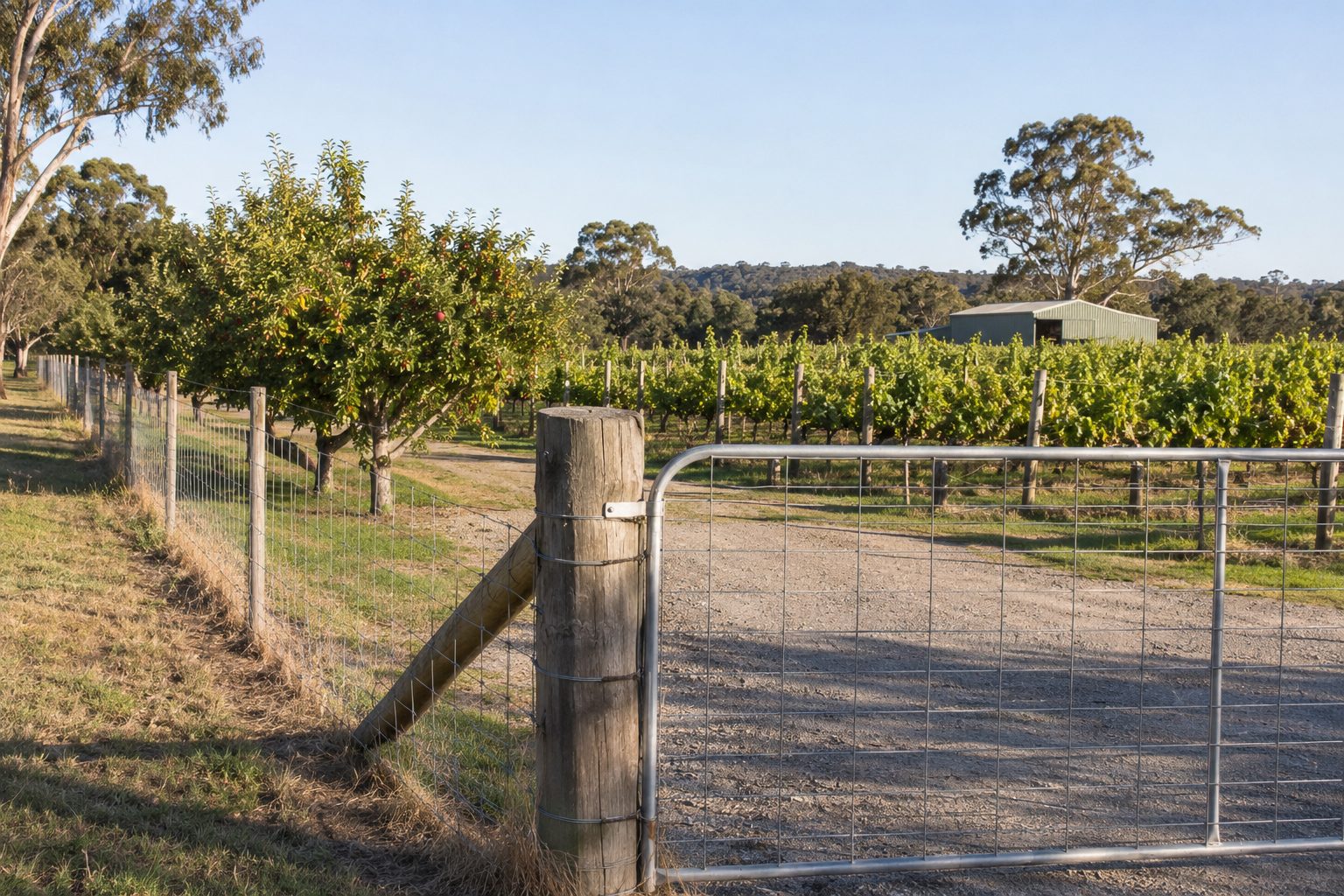
Canals and channels matter for fencing because a fence beside one raises questions this research cannot answer: who manages the bank or reserve, where the fence may sit, and what access the channel operator needs. We found no source on fence rules beside irrigation channels. Ask the council that covers the land and ask the contractor before the line is pegged. The neighbouring irrigation town of Leeton leans more to rice, grain and channels, and has its own page: rural fencing around Leeton.
Vineyard and orchard fencing around Griffith: questions to ask
The sources give no crop-specific fence rules for vines or orchards, so what follows are questions to put to a contractor, not statements of fact.
- How wide are the gates your tractors, sprayers and harvesters need, and where along the headland should they sit?
- Will the fence leave room at the row ends for machinery to turn, and how far will it stand from the first row or trunk?
- Does the fence share anything with an existing trellis or windbreak, or stay clear of it?
- What must it keep out or in: stock, pest animals, or only trespass? The pest animal and wild dog page covers what the sources say about fencing and biosecurity.
- Who is the neighbour on each side, and has a notice been served? The farm boundary fencing page and the guide to who pays for a dividing fence set out the process.
For a small block with a few horses beside a house, see horse and lifestyle block fencing. On approvals, NSW Planning says fences can be built without planning approval in many circumstances and sets limits for rural zones. Farm fences are not named on that page, so confirm with the council, and see the approvals and clearing page for how planning, clearing and licensing differ.
Yenda, Hanwood and the villages near Griffith
Wikipedia lists Yenda, Hanwood, Yoogali, Tharbogang and Beelbangera as places near Griffith, and gives Yenda as about 15 km away. It is a secondary source and we have no distances for the others. An enquiry from any of them is covered as Griffith and surrounds. The Carrathool local government area (the Hillston district) shows a different pattern again. At the 2021 Census it had 2,866 people, with other grain growing at 135 people (9.2 per cent) and grain-sheep or grain-beef cattle farming at 98 (6.7 per cent), according to its ABS page. That is a grain-led pattern, which may change what you ask a contractor.
Rain, heat and what to ask about ground
The Bureau of Meteorology's Griffith Airport station averages 403.2 mm of rain a year over 48.3 days with 1 mm or more. The mean annual maximum is 24.2°C, the January mean maximum 33.5°C and the July mean minimum 3.4°C. The temperature record is from 1970 and the rainfall record from 1958 (station averages). We found no source tying these figures to how posts or strainers behave, so ask the contractor how they will set strainers on your ground and how they allow for irrigation water along the line.
What to send with a Griffith enquiry
Send the locality, the rough length, the crop or stock the fence serves, who the neighbour is, any channel, road or reserve on the boundary, and photos of the line. Before you accept a quote, read the guide to choosing a contractor and checking a quote and ask which licence or registration the contractor holds for your job. Griffith is about 191 km from Wagga Wagga, according to a secondary source. Contractors also service these areas from Wagga Wagga; enquiries from the Wagga Wagga area are better served by our Wagga Wagga site. When you are ready, send your details.
What this page cannot tell you
It cannot tell you what a fence will involve on your block, or which crops, vines or trees sit beside your boundary. We found no fence rules specific to vines, orchards or irrigation channels, and the census figures count jobs, not hectares. It cannot say whether your fence needs council approval, who manages a channel bank, or what any contractor will charge.
Ask the council, the channel operator and the contractor, and ask NSW Fair Trading or Building Commission NSW if you are unsure about licensing.
Check the current rules before you rely on this
This page describes the land, census figures and climate around Griffith and the Murrumbidgee Irrigation Area, and what to ask about vine, orchard and small-holding fences. It describes the rules in general terms as they stood in November 2026. Standards, forms, thresholds and fines change.
The authoritative sources are ABS 2021 Census QuickStats: Griffith (local government area), ABS 2021 Census QuickStats: Griffith (suburb and locality), Bureau of Meteorology, Griffith Airport AWS climate statistics (station 075041), Wikipedia, Murrumbidgee Irrigation Area (secondary source) and NSW Planning, fences (exempt and complying development). Where anything here differs from those sources, they are right and we are not.
We are not fencing contractors, builders, regulators or lawyers. For what applies to your fence, ask the contractor which licence or registration they hold for your job, then ask NSW Fair Trading or Building Commission NSW if you are unsure, and ask the council that covers the land.
Accurate at the time of writing, November 2026. Always check the source before relying on it.