Sheep fencing in the Riverina: what this page covers
Sheep fencing in the Riverina starts with the wire, the posts between and the braced end assemblies, and a quote should name each. The wire choices include netting such as hinge joint and plain line wires. This page explains the options, the words a quote will use, and what to ask before you agree to anything. We are a referral service: your enquiry is passed to a local contractor, who does the work and is responsible for holding any licence or registration that applies.
The page is about livestock type, wire grade and mesh. Shared boundaries and neighbours are on the farm boundary fencing page, and what moves the price is in the cost factors guide.
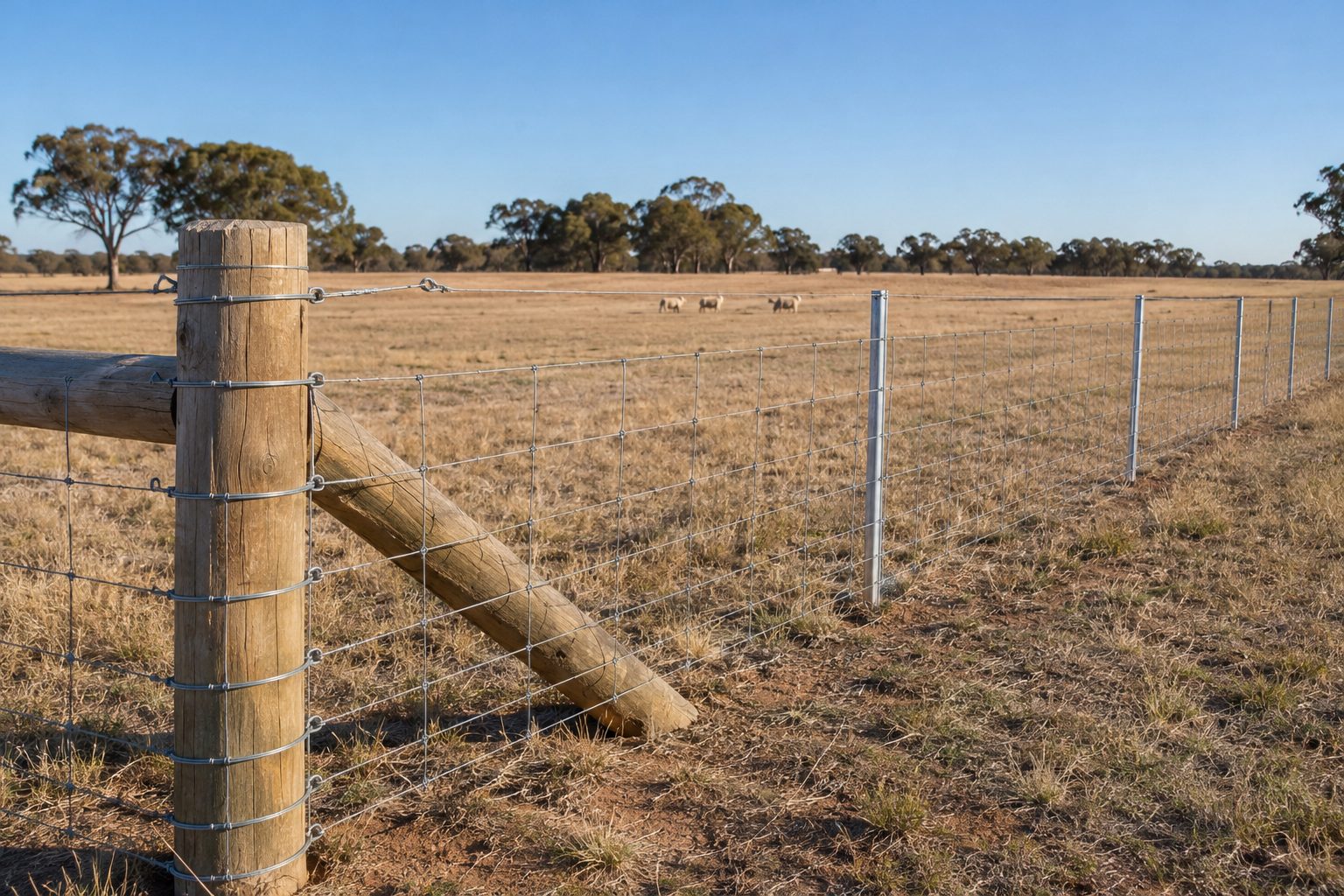
Hinge joint, ringlock and plain wire
Many landholders search for ringlock as well as hinge joint. The only data sheet we found uses the term hinge joint, so that is the term used here. One manufacturer's hinge joint livestock fence data sheet describes netting made of horizontal line wires joined by vertical wires at set spacings. It lists three grades, which are set out below. The sheet gives no post spacing, strainer spacing or height guidance we could use, so none is given here.
| Grade on the sheet | Wire sizes it lists | Ask the contractor |
|---|---|---|
| C (mild steel) | Top and bottom wires 3.0 mm, infill wires 2.5 mm | Whether this grade is quoted, and why it suits your stock. |
| Light high tensile | 2.5 mm and 2.0 mm | Which wires are 2.5 mm and which are 2.0 mm in the product quoted. |
| High tensile | 2.5 mm throughout | What straining and bracing the contractor allows for. |
The sheet's range includes products with eight line wires, and a "lamb-friendly" netting with vertical wires 22 cm apart. It also makes coating claims for its own product. Those are the manufacturer's claims, so they are not repeated here. Ask the contractor to write the product, the grade and the number of line wires into the quote, so two quotes can be compared like for like.
Posts, strainers and gates
Strainer assemblies take the load at fence ends, corners and gateways. The sources we read give no strainer or post spacing for New South Wales conditions, so this page gives none. Ask the contractor how many assemblies the quote includes, what they are made of, how they are braced, and how the gates are hung.
For timber, a timber industry education body sorts species into four durability classes for in-ground use, with class 1 the most durable. It says posts ideally come from class 1 or class 2, and that treated softwood posts should be specified to H4. How long any post lasts is a separate question, covered on the fence life page. Ask which species and class, or which treatment level, is in the quote.
Where stock fencing is the main job
Stock fencing matters most in the grain, sheep and beef country. At the 2021 Census the Australian Bureau of Statistics (ABS) lists grain-sheep or grain-beef cattle farming at 5.2 per cent in the Temora local government area (ABS QuickStats, Temora local government area) and 12.3 per cent in the Lockhart local government area (ABS QuickStats, Lockhart local government area). It lists specialised sheep farming at 7.5 per cent in the Hay local government area (ABS QuickStats, Hay local government area) and specialised beef cattle farming at 4.9 per cent in the Snowy Valleys local government area (ABS QuickStats, Snowy Valleys local government area).
These are employment shares. They show where the work is, not how many paddocks or kilometres of fence there are. Local pages: Temora and the eastern Riverina and Tumut and the Snowy Valleys.
What counts as a standard rural fence
People often ask what a standard rural fence is. The Dividing Fences Act 1991, in the version we found dated 7 December 2024, does not define a sufficient dividing fence. A court or tribunal looks at all the circumstances, such as the existing fence, how the land is used, local fence types and council policies. No standard height appears in the sources we read. For a shared boundary, the dividing fences guide explains the process.
Stock, roads, flood country and machinery
The owner of the stock carries the duty to keep them off a public road. NSW Police says owners are responsible for making sure their stock do not stray onto a public road, and that stray stock contributing to a crash may bring a criminal charge. The page does not mention fences. Roads, reserves and Crown land are covered on the roads and stock routes page.
On flood-prone country, Victorian Government guidance for riparian fences in flood-prone areas, an interstate source, says plain wire is easier to clean up and re-strain than mesh or barbed wire (the Victorian guidance). That is guidance for creek and river frontages in another state, offered as one source of ideas. If a fence line floods, say so when you enquire, and see the repair page.
Machinery safety on a fencing job
SafeWork NSW says to check that machine danger points are guarded, for example on post hole diggers and power take-off shafts, and to keep loose clothing and gloves away from rotating parts. If you are helping with the work, or the contractor is working on your land, ask how guarding and tractor protection are handled. The contractor guide has the full list of questions.
What to put in the quote
Ask for the fence length and how it was measured, the netting or wire grade, the number of line wires, the post and strainer material, the gates, who supplies materials and what happens to the old fence. Compare at least two written quotes line by line. The contractor, not this site, sets the price, and the contractor decides which design suits your ground.
What this page cannot do
It cannot design a fence for your paddock, because the right wire, height and bracing depend on your stock, your ground and your fence line. It cannot give a price or a lifespan, and it cannot say which licence or registration a contractor holds or whether one applies, because the pages we found do not say. The wire details come from one manufacturer's data sheet and are not a New South Wales standard. Ask the contractor, the council and NSW Fair Trading or Building Commission NSW about your job.
Check the current rules before you rely on this
This page describes sheep and cattle fence options, one data sheet's wire grades and where stock owners' duties sit. It describes the rules in general terms as they stood in November 2026. Standards, forms, thresholds and fines change.
The authoritative sources are One manufacturer's hinge joint livestock fence data sheet (manufacturer claims are the manufacturer's), Australian timber industry education body, fencing (durability classes and treatment), Dividing Fences Act 1991 (NSW), in-force version dated 7 December 2024 (check the current version), SafeWork NSW, machinery on farms and NSW Police, straying stock on public roads. Where anything here differs from those sources, they are right and we are not.
We are not fencing contractors, builders, regulators or lawyers. For what applies to your fence, ask the contractor which licence or registration they hold for your job, then ask NSW Fair Trading or Building Commission NSW if you are unsure, and ask the council that covers the land.
Accurate at the time of writing, November 2026. Always check the source before relying on it.