Horse fencing in the Riverina: the options and the gaps
Horse fencing on a small acreage in the Riverina usually comes down to three families of fence: post and rail, post and wire, and electric. Contractors describe all three, and each has trade-offs that depend on the horse, the paddock and the budget. We looked for a horse fencing standard and for guidance on wire types for horses, and found neither, so this page does not rank the options. It sets out what the planning and timber sources say and what to ask. This is a referral site: your enquiry is passed to a local contractor, who is responsible for holding any licence or registration that applies.
What the planning page lists for rural zones
NSW Planning says fences can be built without planning approval in many circumstances. In rural and environmental protection zones and R5 villages, exempt fences must not exceed 1.8 m and must use post and wire or post and rail systems. Stepped fences on slopes can reach 2.2 m per step. Masonry is allowed only within 3 m of a driveway entrance. The exemption does not apply to heritage items, conservation areas or critical habitat. A fence outside these terms needs a full application to the council.
Farm and horse fences are not named on that page, so confirm with the council that covers your land before you order. The approvals and clearing guide covers the details and keeps planning, clearing and licensing apart.
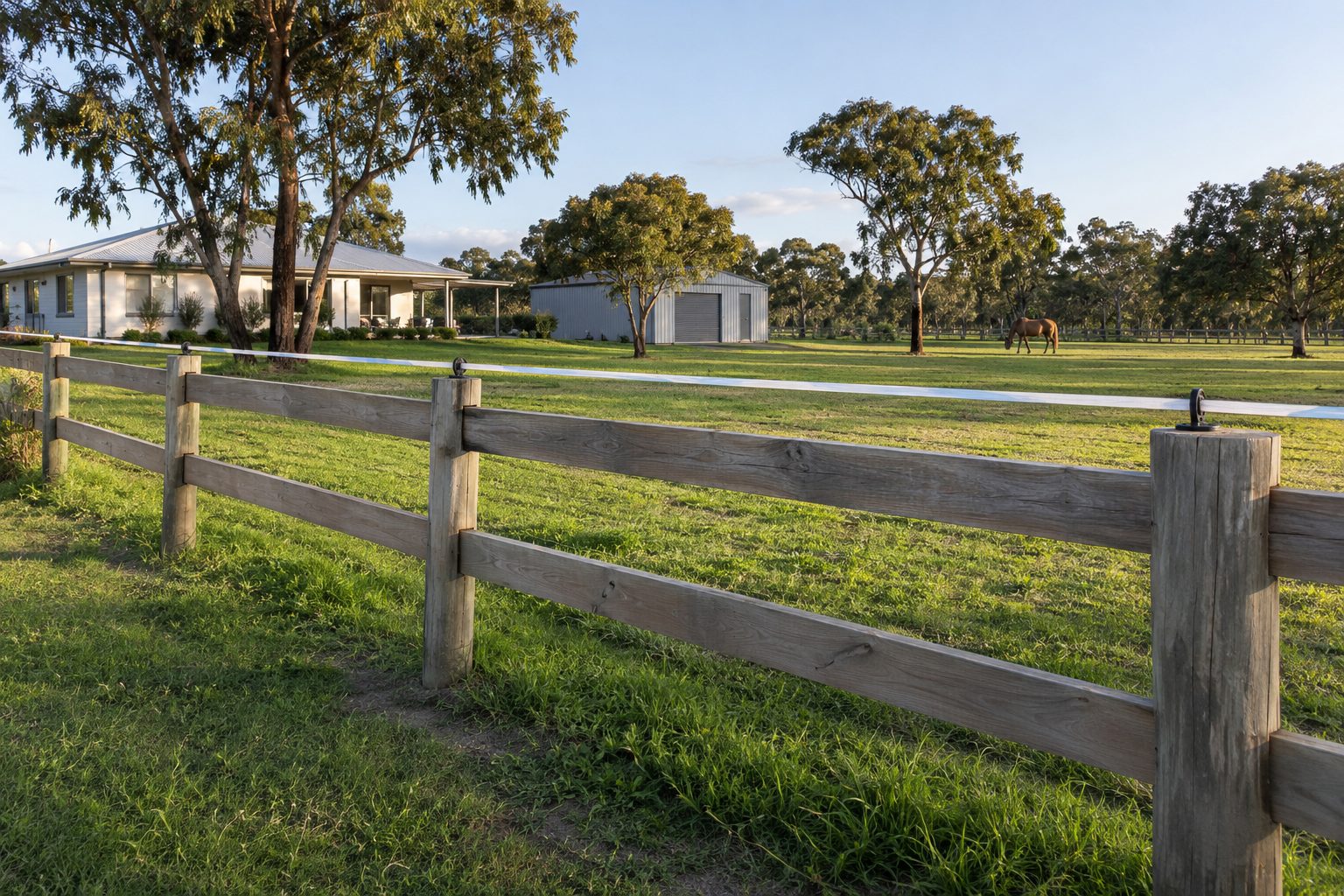
Post and rail, post and wire, and electric tape
Post and rail uses horizontal timber rails fixed to posts. Post and wire strains wire between braced ends. Electric tape or wire can be added along the top or inside an existing fence. For wire, the one flood-country source we have says plain wire is easier to clean up than mesh. That says nothing about horses, so ask the contractor why a given wire is quoted for yours. For the electric option, the electric fencing page covers energisers, earthing and running parts.
Ask for these things in writing: the fence type, the number of rails or wires, the height, the post spacing, the gate sizes, and how the corners and ends are braced. Ask whether the contractor has built horse fences before. No source we read sets any of these for New South Wales, so the contractor's specification is what you are buying.
Timber for posts and rails
A timber industry education body sorts timber species into four durability classes for in-ground use, with class 1 the most durable, and says treated softwood posts should be specified to H4. Rails above the ground face different conditions from posts in it, so ask what is quoted for each. How long timber lasts is covered on the fence life page.
Clearing a line on a smaller holding
NSW Government lists fences as rural infrastructure for native vegetation clearing, with maximum widths that differ by category. For smaller holdings the page lists 12 m. Confirm which category applies to your land before any clearing, and ask Local Land Services if you are unsure. Do not assume a distance from this page.
A lifestyle block next to a farm
If your block adjoins a working farm, the Dividing Fences Act 1991, in the version we found dated 7 December 2024, looks at all the circumstances, and we did not find a rural-specific provision or any that treats a farm neighbour and a lifestyle neighbour differently. Ask a solicitor. In practice it helps to raise the fence early, because stock on one side and horses on the other make the standard a real conversation. The dividing fences guide sets out the process, and the cost factors guide shows what a quote should itemise.
What to send when you enquire
Tell the contractor how many horses use the paddock, whether they are kept in all year or moved, how big the paddock is, whether it is a boundary or an internal fence, and what is already there. Say if the line runs near a driveway, a house or a shed, because the planning page treats masonry near a driveway entrance differently. Send a photo of the line and of any gateway. If a neighbour is involved, say whether they have agreed. Ask about timing, since a small job can still wait on materials and access.
What this page cannot do
It cannot say which fence is safest for a horse, because we found no horse fencing standard or wire advice. It cannot design a paddock, decide whether your fence is exempt from planning approval or say which clearing category your land falls in. It cannot tell you which licence or registration a contractor holds, or whether one applies. The lifestyle block angle is our reading of the sources, not a finding: none of them gives lot sizes or counts. Ask the contractor, the council and a solicitor.
Check the current rules before you rely on this
This page describes the fence options for horse paddocks and small rural blocks and what the planning and clearing pages say about them. It describes the rules in general terms as they stood in November 2026. Standards, forms, thresholds and fines change.
The authoritative sources are NSW Planning, fences (exempt and complying development), NSW Government, native vegetation allowable activities (rural infrastructure, fences), Australian timber industry education body, fencing (durability classes and treatment) and Dividing Fences Act 1991 (NSW), in-force version dated 7 December 2024 (check the current version). Where anything here differs from those sources, they are right and we are not.
We are not fencing contractors, builders, regulators or lawyers. For what applies to your fence, ask the contractor which licence or registration they hold for your job, then ask NSW Fair Trading or Building Commission NSW if you are unsure, and ask the council that covers the land.
Accurate at the time of writing, November 2026. Always check the source before relying on it.