Licensing rules differ by job. The NSW Government fencing page we found speaks about fencing on residential property boundary lines, and we could not confirm that it covers rural or farm fencing. Ask the contractor which licences and insurance apply to your job, check NSW Government licence guidance, and ask NSW Fair Trading or Building Commission NSW if you are unsure.
That is the one point on licences this page will make, and the rest is about how to choose a fencing contractor for a farm: what to ask, how to read a written quote and what to do when something does not add up. We are a referral service. Your enquiry is passed to a local contractor, and the contractor is responsible for holding any licence or registration that applies.
How to choose a fencing contractor for a farm
Start with the job, not the contractor. A contractor can only quote well if you have said what the fence must hold, where it runs, how long it is, what the ground is like and who the neighbour is. The enquiry form asks for exactly that. Then ask each contractor the same questions in the same order, so the answers can be compared.
Ask two or three contractors for a written quote. A phone price is a starting point, not a quote. Ask each to visit the line if the job is large, if the ground is difficult or if the fence is a shared boundary.
What to ask before you accept a quote
- The line. Who locates the fence line, how the length was measured and whether a survey is needed.
- The fence. The type, the wire type and number of wires, and what each is meant to hold.
- Posts and strainers. The material, the species or treatment class and the spacing.
- Gates. How many, what size and what type.
- Materials. Who supplies them, and what is done if a delivery is short.
- The old fence. Whether removal and waste are included.
- Access. What the quote assumes about tracks, machinery and the time of year.
- Surprises. What happens if rock or wet ground is found on the day.
- Services. Who arranges powerline and underground service checks.
- Payment. How it is staged, and what triggers each payment.
- Paperwork. The licence, registration and insurance details the contractor says apply.
- The neighbour. Who prepares and serves any notice on a shared boundary.
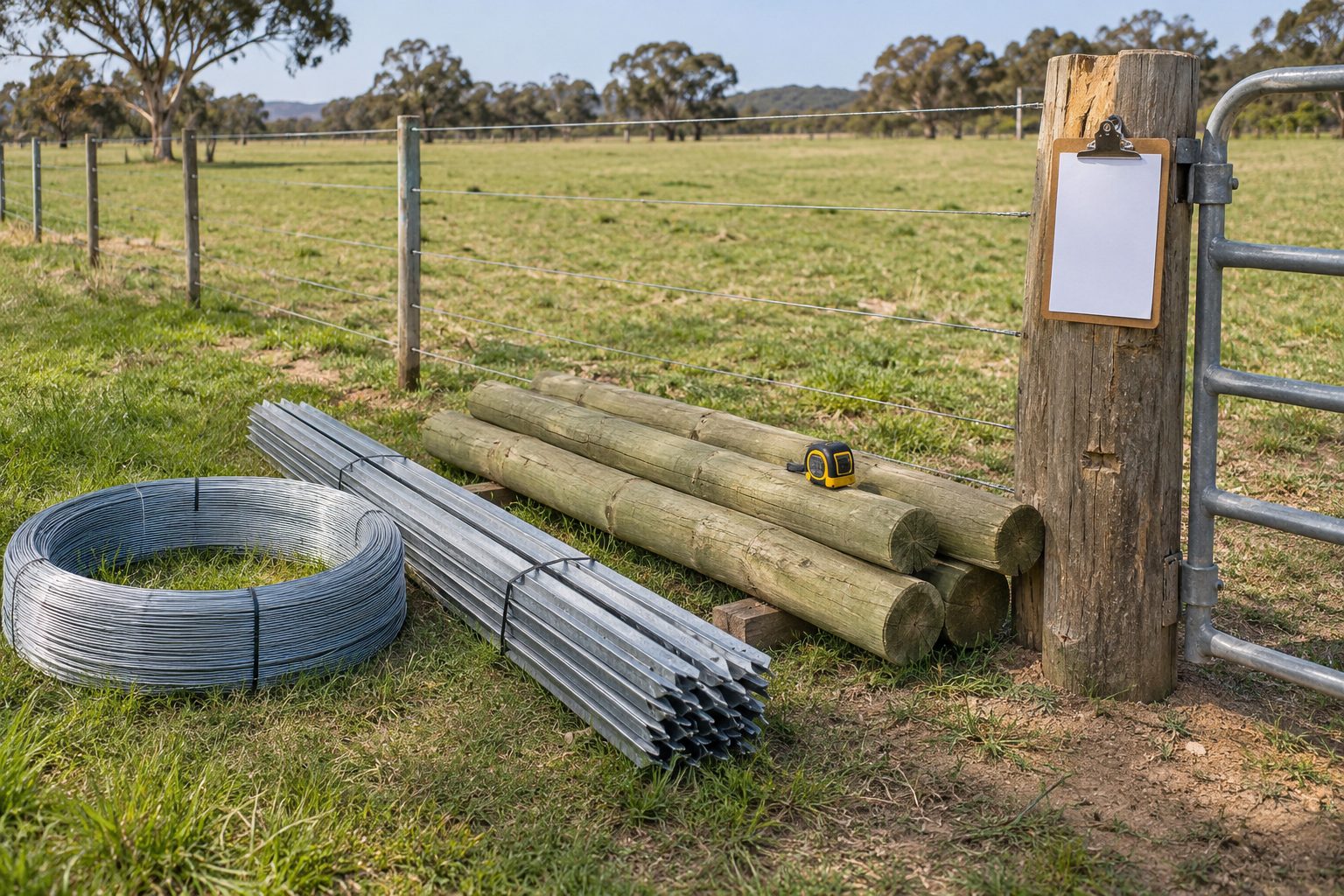
How to check a fencing quote line by line
Put the quotes side by side and go through them one line at a time. The price drivers are explained on the cost factors page. This page is about reading the quote itself. Where one quote names something and another is silent, that is the first thing to ask about.
| If the quote says | What it can hide | What to ask |
|---|---|---|
| Posts supplied | No species, treatment class or size is named, so a lower-rated post could be priced against a higher-rated one. | Which species or treatment class, and how deep each post is set |
| Fence supplied and erected | No wire grade or number of wires, so two fences that look alike may not be. | Which wire grade and how many wires |
| Gates included | The number, width and type of gate are not listed. | Each gate listed with its size and type |
| Allowance for access | It is unclear whether wet ground, rock or a hard-to-reach line is covered. | What is in the allowance and what is charged extra |
| Neighbour paperwork | Nothing is said about who prepares or serves a notice. | Who does it, and whether it is in the price |
| Total only | No lines to compare, so a gap between quotes cannot be traced. | An itemised version of the same quote |
If a quote is vague, do not guess. Ask for it in writing again with the missing lines filled in. A contractor who cannot say what is in the price is telling you something. A contractor who answers each line clearly gives you a quote you can hold them to.
Licence, registration and insurance questions
Planning approval, native vegetation clearing and licensing are three separate questions, and this page deals only with the last. The approvals and clearing guide covers the first two. On licences, the NSW Government fencing page defines fencing as work within or on residential property boundary lines and does not mention rural, farm, paddock or stock fencing. A second NSW Government page, on categories of work, lists fencing work and likewise carries no rural or agricultural mention. Neither page answers the question for a stock or paddock fence, so we do not either.
What you can do is ask. Ask the contractor which licence or registration they hold for your job, which regulator issues it and what insurance they carry. Ask for the details in writing and keep them with the quote. If the answer does not make sense to you, ask NSW Fair Trading or Building Commission NSW. We give no thresholds, deposit limits or warranty periods, because none were confirmed for rural fencing.
Machinery, powerlines and site safety
Fencing uses post hole diggers, augers, tractors and loaders, and SafeWork NSW guidance covers them. It says to check that machine danger points are guarded, giving post hole diggers and power take-off shafts as examples, to keep loose clothing and gloves away from rotating parts and to switch off before maintenance. Its fact sheet adds rollover protection on tractors, protection for the operator when a loader is fitted, and workers who are inducted, trained and supervised. Ask the contractor how they handle each point on your property (SafeWork NSW machinery guidance and its farm machinery fact sheet).
Powerlines need their own question. The regional electricity network operator's agriculture safety guide says to stay at least 8 m from a line and anything touching it, and it treats machinery over 4.6 m high as higher risk. Tell the contractor where lines cross the property, and ask who arranges powerline and underground service checks before any hole is dug.
References, earlier work and what to do if the work differs from the quote
Ask to see photos of earlier work of the same kind, and ask for a landholder you can phone. We make no claim about any contractor, and the photographs on this site are illustrative only. Look for fence types like yours: a stock fence, a boundary fence, an electric fence or a flood repair.
Once work starts, keep dated photos of the line before, during and after. If the work differs from the quote, ask for the change in writing before more work is done. If you cannot agree, ask NSW Fair Trading or Building Commission NSW what steps are open to you. For a shared boundary, the farm boundary fencing page and the dividing fences guide explain the neighbour side.
Matching the question to the job
Different jobs raise different questions. For stock fences, see sheep and cattle fencing. For energisers and earthing, see electric fencing. After a flood or fire, see flood and fire damaged fence repair, and for small blocks, horse and lifestyle block fencing.
What this checklist cannot do
A checklist cannot tell you whether a contractor is the right one, which licence applies to a particular fence or what insurance covers your job. We do not check or recommend any contractor, and we do not vouch for the work. We do not quote, build or sign contracts. Your enquiry is passed to a local contractor, who sets their own terms.
The questions above are a way to get clear answers in writing. Where a question touches a rule, the regulator or the council is the source, and where our page and theirs differ, theirs is right.
Check the current rules before you rely on this
This page describes how to choose a rural fencing contractor, compare written quotes and raise licence, insurance and safety questions. It describes the rules in general terms as they stood in November 2026. Standards, forms, thresholds and fines change.
The authoritative sources are NSW Government, fencing work (licences and credentials; speaks about fencing on residential property boundary lines), NSW Government, categories of building and trade work (lists fencing work; no rural or agricultural mention), SafeWork NSW, machinery on farms, SafeWork NSW, farm machinery fact sheet and Electricity network operator, electricity and agriculture safety guide (PDF). Where anything here differs from those sources, they are right and we are not.
We are not fencing contractors, builders, regulators or lawyers. For what applies to your fence, ask the contractor which licence or registration they hold for your job, then ask NSW Fair Trading or Building Commission NSW if you are unsure, and ask the council that covers the land.
Accurate at the time of writing, November 2026. Always check the source before relying on it.